
Born Into Opportunity
The economics of class, geography, and social mobility in Britain

William and Jon are the same age. Same ethnic background and none of them has any disabilities. They achieved exactly the same A-level grades. They attended schools with similar academic performance. They even scored almost identically on an IQ test. Both receive an interview invitation from University of Oxford.
William passes comfortably.
Jon fails badly.
Why?
At first glance, this should make little sense. If meritocracy worked as we imagine, both students should have had roughly the same probability of success. Yet the reality of social mobility is that talent alone is not always enough.
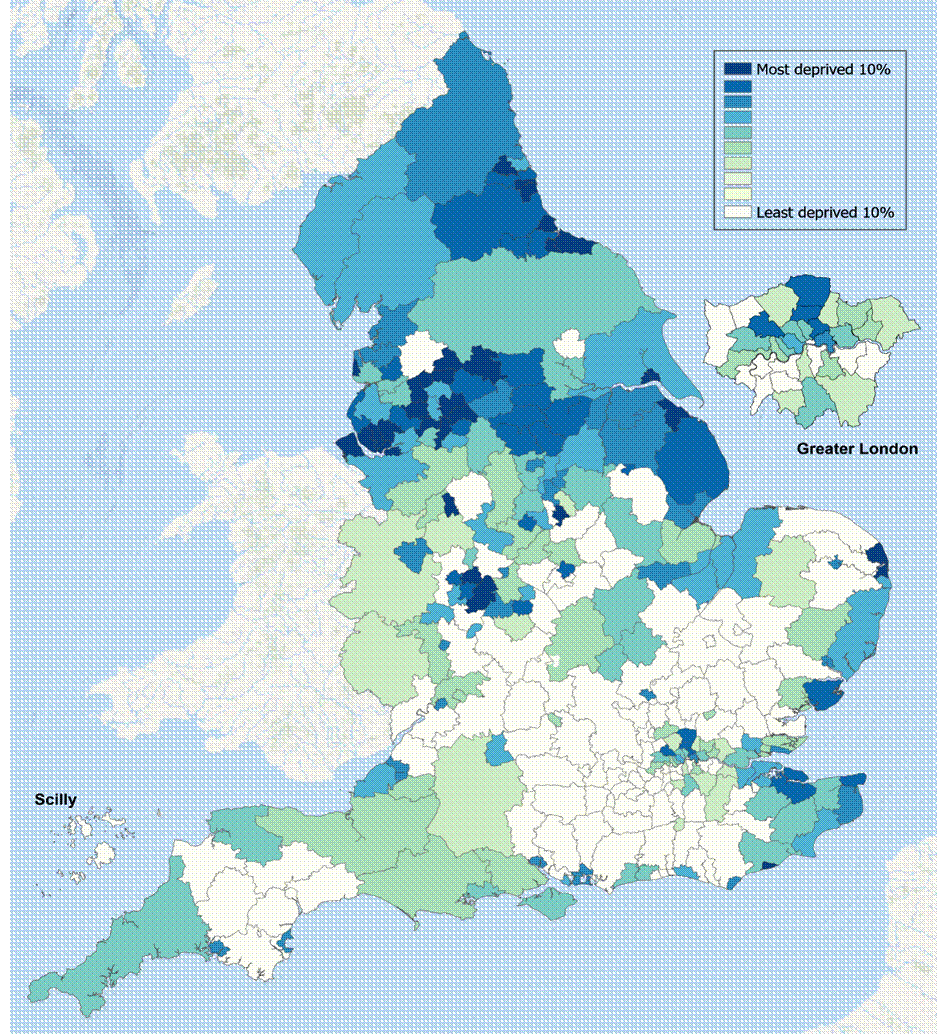
Jon grew up in Blackpool, one of the most deprived areas in England and Wales. Reaching an Oxford interview at all was statistically extraordinary. In his school, very few students achieve grades above the national average, and even fewer apply to elite universities. Nobody in his immediate circle could explain what an Oxford interview looked like, how to prepare for it, or even what kinds of answers tutors were looking for.
Jon’s experience was not unique. The divide between him and William had been shaped long before the interview itself.
Blackpool is the most deprived Local Authority, while Richmond scores as the least deprived
The week before the interview, Jon worked overtime shifts so he could afford the overnight coach journey to the south of England. He arrived in Oxford exhausted. The old buildings, the formalities, the confidence of other applicants, all of it felt alien. Every corridor reminded him that he did not belong there.
William’s experience was different long before the interview began. He spent the previous week staying with his uncle in Cambridge, an economics lecturer who coached him through mock interviews. Through family friends, he met current students from University of Oxford and London School of Economics and Political Science who explained the hidden rules of the process: how to structure answers, how to challenge tutors confidently, how to “think out loud” in the way elite universities expect.
When William entered the interview room, he recognised the culture. When Jon entered, he encountered it for the first time.
Both students were intelligent. But intelligence is only one ingredient in success. Confidence, networks, financial stability, cultural familiarity, and simple exhaustion matter too. And this is the uncomfortable truth about social mobility in Britain: by the time elite institutions evaluate “potential,” inequality has already shaped who can demonstrate it.
The odds were already uneven long before either student entered the interview room. For Jon, reaching the grades to get an interview for Oxford is already against the odds. The average Attainment 8 score (Attainment 8 is a measure of a student’s average performance across eight GCSE subjects, weighted to reflect the importance of English and Maths) in Blackpool is 37, while the national average for England is 46. But for William, who grew up in Richmond, the average Attainment 8 score was 56.6, much higher than the national average. To make things worse Jon is coming from a disadvantaged background as he was relying on free school meals; only 25.8% pupils from a disadvantaged background managed to achieve grades 5 or above in English and Mathematics GCSEs in England, compared with 53.1% of non-disadvantaged children achieving the same grades during 2024/25.
These inequalities continue all the way to elite university admissions. Oxford University received 974 applications from young people that received free school meals while they were pupils. Only 243 achieved an offer in 2024, which represents 8.1% of the Oxford admissions.
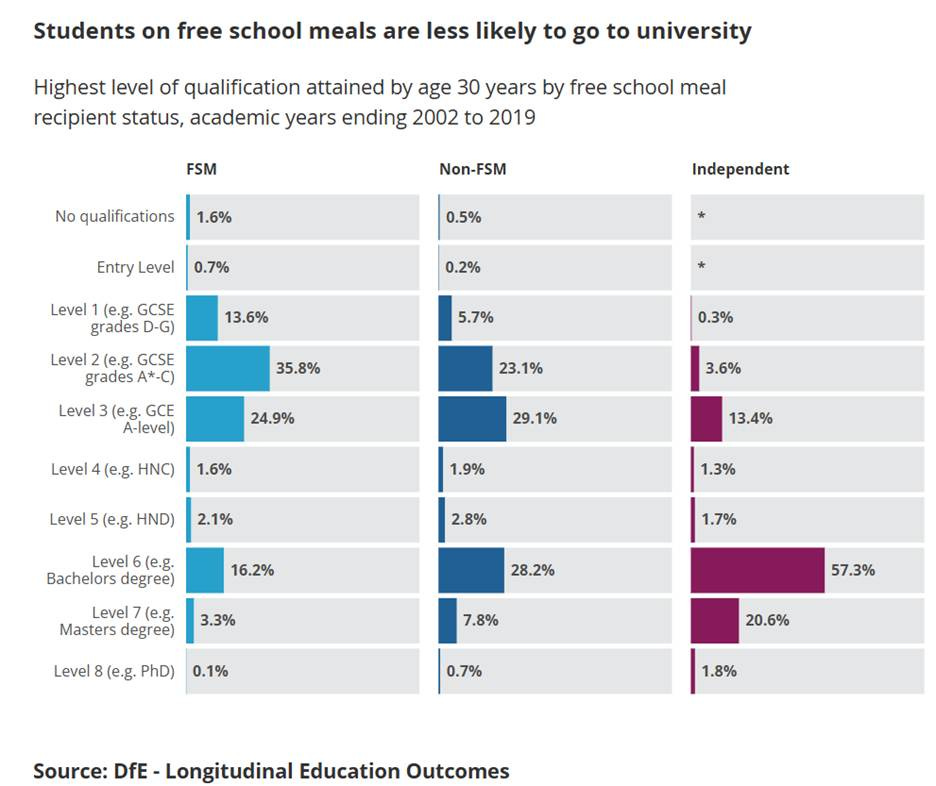
The inequalities did not end with the interview. Unable to afford the extraordinary cost of living in southern England, Jon stayed in the north and attended the University of Liverpool to study economics. He has already beat the odds - even reaching university represented upward mobility against the national trend. Only 16.2% of students receiving FSM manage to get into the university according to research from ONS. 48.2% of 25-29 year olds are now in professional occupations, up from 36.1% a decade ago, but access remains heavily skewed towards privileged backgrounds.
Unlike many of his classmates, university for Jon was not just lectures and libraries. It was survival. He worked minimum wage shifts to pay rent, often balancing late-night work with early morning seminars. While other students revised during holidays, Jon picked up extra hours. Yet despite the exhaustion, he excelled academically. He graduated with distinction.
William’s university experience looked very different. At the University of Oxford, grades mattered, but they were only part of the opportunity. William understood that the real value of elite institutions often lies beyond the classroom.
He joined the rowing team at Magdalen College, Oxford. He attended formal dinners in black tie, debated politics at student societies, and spent evenings networking with academics, alumni, consultants and future politicians. These spaces quietly taught him how power speaks, dresses, jokes and recruits.
By the time William graduated with an upper second-class degree, he had already secured internships at a London economic consultancy and a finance firm through connections he had built during university.
Jon applied for the same internships. Most rejected him before the interview. Eventually, he secured an internship with the UK Civil Service, one of the few large employers with relatively blind recruitment processes regarding university background. Even then, success did not come naturally. Jon relied heavily on guidance from mentors who explained how to navigate application forms, competency frameworks, and assessment centres, systems that often feel intuitive only to those already familiar with professional middle-class environments.
This is how inequality reproduces itself. Not through one dramatic act of exclusion, but through thousands of smaller advantages that accumulate over time: confidence, contacts, unpaid opportunities, cultural familiarity, financial safety nets, and access to people who know how the system works.
By adulthood, William and Jon no longer appear equal on paper. But the gap between them was never simply about talent. It was about the unequal distribution of opportunity surrounding that talent. Recent Social Mobility Commission analysis found that although more young people are entering professional occupations overall, the gap between those from privileged and working-class backgrounds has widened in recent years.
And the inequalities did not disappear once education ended. According to research from ONS 50% of people who were on free school meals earned £17,000 or less aged 30 years during 2017 and 2019. With the top 1% of free school meals students earned around £63,000. By contrast, of state school students not on free school meals, individuals would need to earn over £85,000 a year to be in the top 1%. Their earnings were at least double the salary of 90% of individuals in this group.
Further evidence from DfE mentions that the gap in median earnings between graduates whose families claimed free school meals and those whose families did not decreased in 2022-23 compared to 2016-17. Since the 2016-17 tax year, the difference in median earnings of FSM graduates compared to non-FSM graduates has fluctuated between 12.0% less and 8.4% less.
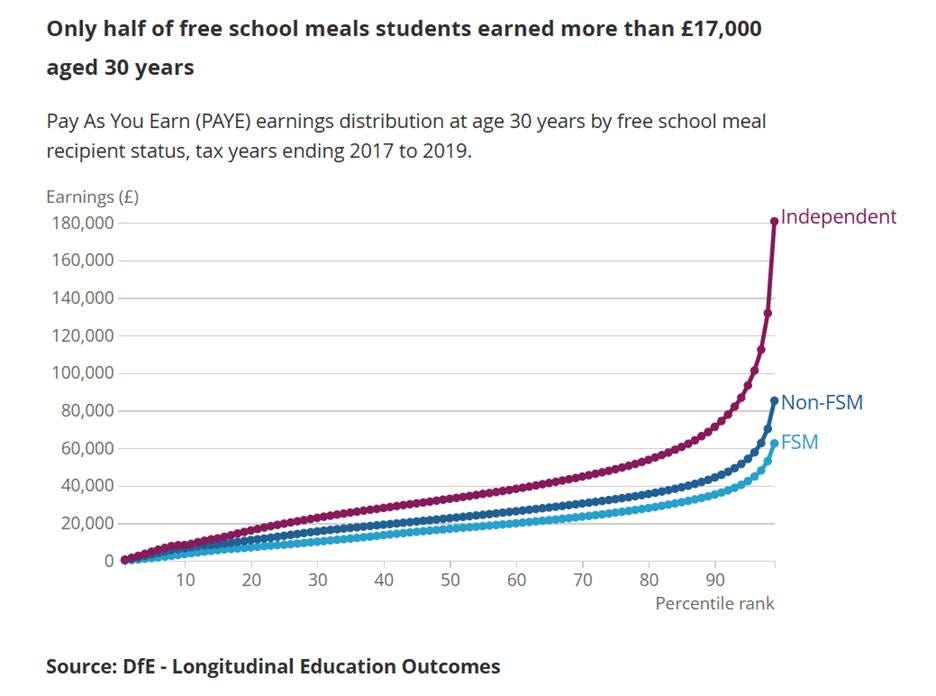
But one large element of the earnings depends on where the individuals live. If FSM pupils remain in deprived areas, their earnings will be lower than those pupils who received FSM support and moved to London. According to the Social Mobility Commission, the best opportunities for high qualifications and professional careers remain concentrated around London and the Home Counties, while many northern coastal towns continue to experience significantly weaker social mobility outcomes.
Deprivation alone does not explain Britain’s mobility gap. Geography matters too. Young people from disadvantaged backgrounds in London are substantially more likely to progress into higher education and professional careers than similarly disadvantaged young people growing up in northern England. The Social Mobility Commission has warned that economic opportunities in Britain are increasingly “over-concentrated” in specific regions, leaving many post-industrial and coastal communities trapped in long-term disadvantage. The Commission described many northern and coastal communities as facing “deep-rooted disadvantages” after decades of economic decline, with poorer childhood conditions, weaker labour markets and fewer professional opportunities.
And even when individuals overcome these barriers, inequality often persists. Recent Social Mobility Commission analysis found even when qualifications are held constant, background still matters. Recent Social Mobility Commission analysis found that young people from professional backgrounds earned around 19% more than peers from working-class backgrounds with equivalent qualifications.
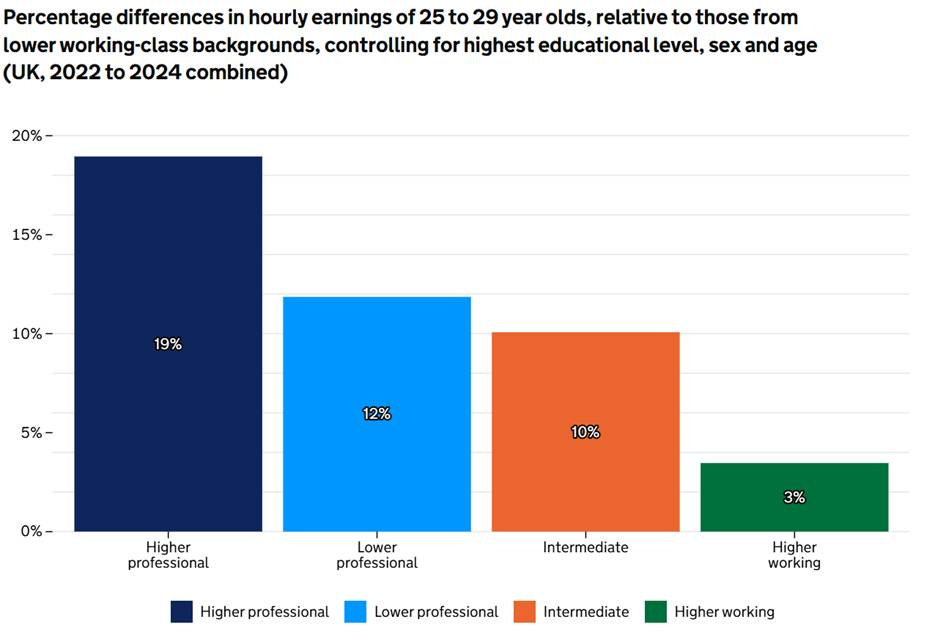
Entering elite professions does not necessarily eliminate class disadvantage either. Research published in 2023 found that professionals from working-class backgrounds earned on average around £6,300 less per year than colleagues from more privileged backgrounds working in similar occupations.
Recent evidence submitted by the Social Mobility Commission to Parliament warned that national averages often mask “compounding barriers” faced by disadvantaged young people growing up in deprived regions. The consequences extend far beyond individual lives. Britain’s social mobility crisis is not only unfair; it is economically wasteful. Demos/Co-op analysis estimated that weak social mobility costs the UK economy around £19 billion annually in lost productivity and growth because talent from disadvantaged backgrounds is unable to fully develop and utilise its potential.
The tragedy of Britain’s mobility crisis is not simply unfairness, it is inefficiency. Brilliant students exist in every town and every classroom, but opportunities remain concentrated among those born closest to wealth, networks and institutional familiarity.
Britain does not lack talent. It lacks equal access to opportunity.
Disclaimer: Not every disadvantaged child will have the same experience as Jon; nor will the path for children from more privileged backgrounds always look like William’s. But the statistics show that where you come from, and your background in life can have real and lasting impact on your prospects.
A very interesting substack. Similar scenarios appear elsewhere in the world, too! The notion that Man is a product of their environment is almost always true, and to break it, you need a lot of work
A fascinating read.
We often hear of social mobility challenges faced by those from under-represented groups but few pieces impose the severity of the issue in a digestible format such as this, supported by visuals. Kudos to you.
A social mobility fact I was introduced to recently that supports this (and provides context to the North-South opportunity divide) is that:
- Children who grow up on FSM in London/Greater London are more likely to go to University and land higher-paying roles than those outside of London, who did not grow up on FSM.
Of course proximity to the financial capital plays a role, but I think it puts into perspective how much proximity to opportunity can play a role in social mobility, even if you grow up in a more "priveleged" society elsewhere.
Totally agree on your point regarding having access to networks that can introduce connections and provide guidance can open doors for those that come from priveleged backgrounds. Nonetheless, it has been refreshing to see an increasing number of social mobility organisations popping up across the country that are supporting kids break down these barriers. Upreach and SEO are the two more well-known ones and I have personally participated in Upreach programmes in the past. Even so, you notice patterns of most employers holding Insight events in London, meaning even if you can expense your way to these events, local London kids can actually maintain and develop the relationships they make at such events thanks to their locality.
Have you had experiences with social mobility challenges yourself? Curious to get your perspective on your own experience but also where the situation is heading for the UK in this context (asking as I believe some political commentators made the decision to pursue legal proceedings against another social mobility organisation which I assume will present challenges for the wider industry and DEI initiatives as a whole).